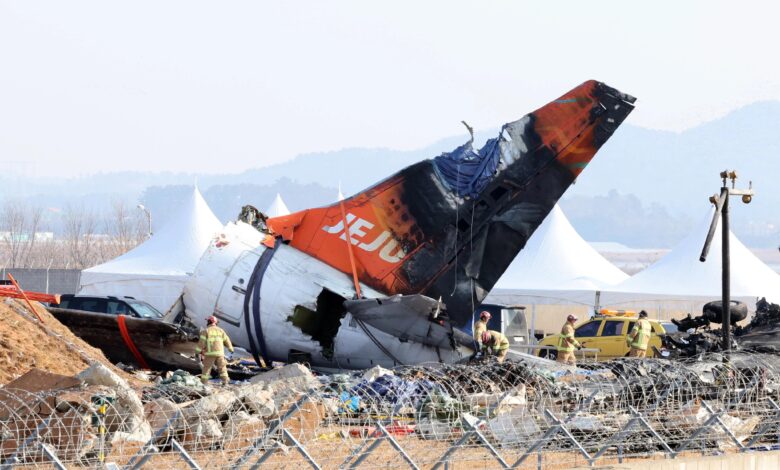
A new audit report has revealed a critical detail in the 2024 crash involving Jeju Air, which killed 179 people. According to investigators, a concrete mound located at the end of the runway at Muan International Airport was built partly as a cost-saving measure.
The structure was originally constructed to support the localizer system, which helps aircraft align with the runway centerline during instrument approaches. Instead of reshaping the terrain, authorities built a raised concrete mound and installed the localizer equipment on top of it to reduce construction costs.
On 29 December 2024, the Jeju Air Flight 2216 arriving from Bangkok performed a belly landing after its landing gear failed to deploy. The aircraft slid down the runway and struck the concrete structure at the runway end, resulting in the deaths of 179 passengers and crew.
The report published by the Board of Audit and Inspection stated that the structure was approved in 2003 by the Ministry of Land, Infrastructure and Transport without a formal risk assessment.
According to the findings, Korea Airports Corporation requested a safety review of the structure in 2007, but no modifications were made.
Furthermore, during an airport modernization program between 2019 and 2024, the concrete mound in Muan and similar structures at four other airports were actually reinforced rather than redesigned.
The audit also found that 14 localizer structures at eight airports across the country were built without meeting required safety standards, warning that these installations pose serious aviation safety risks.