NTSB: Critical Safety Gaps Identified After Helicopter and Passenger Jet Collision Near Washington, DC
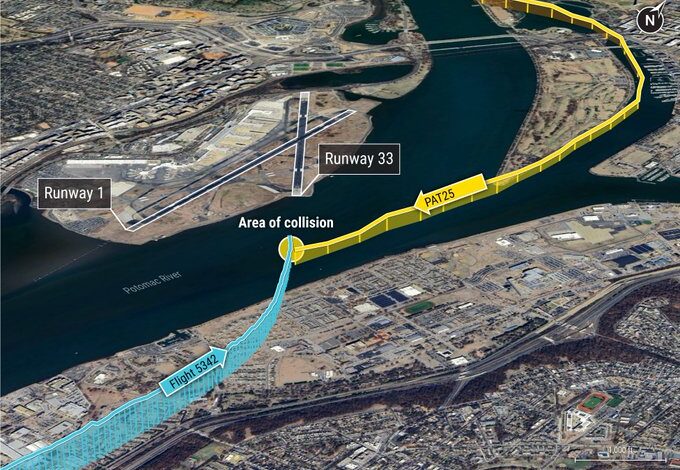
The US National Transportation Safety Board (NTSB) has released its AIR-26-02 report on the mid-air collision near Ronald Reagan Washington National Airport (DCA) over the Potomac River involving a PSA Airlines CRJ700 operating Flight 5342 and a US Army Sikorsky UH-60L Black Hawk helicopter with the call sign PAT25. The accident, which occurred on 29 January 2025, claimed the lives of all on board both aircraft: 2 pilots, 2 cabin crew members and 60 passengers on the CRJ700, and 3 crew members on the helicopter.
Operational background and sequence of events
According to the report, the helicopter departed Davison Army Airfield at Fort Belvoir on an annual standardization evaluation flight conducted using night vision goggles (NVG). It later received tower clearance to transit the DCA area via Route 1 and Route 4.
Around the same time, Flight 5342 arriving from Wichita was initially conducting a visual approach to Runway 1. For traffic flow reasons, the tower requested a change to Runway 33, and after a performance assessment the crew accepted a circling approach to Runway 33 and began the maneuver.
Key findings highlighted in the report
The NTSB listed the design of helicopter routes around DCA, the widespread reliance on pilot-applied visual separation, and the inherent limitations of the “see-and-avoid” concept, including under NVG and at night, among the safety issues relevant to the accident.
The report also emphasized that FAA guidance on helicopter route altitudes and boundaries is not sufficiently clear or consistent, which can lead to misinterpretation by operators.
On the air traffic side, the separation of helicopter and fixed-wing traffic on different frequencies, along with the risk of blocked radio transmissions, was identified as a hazard. Controller workload, position combining, and communication practices were also included among the safety themes addressed in the report.
The NTSB noted that visual separation had effectively become the primary method of separating helicopters from fixed-wing aircraft at DCA, with some statements indicating that pilot-applied visual separation was relied upon “almost continuously” for helicopter–fixed-wing separation.
Traffic density, workload, and the “Runway 33 offload” routine
The report stated that in DCA’s high-volume and complex traffic environment, tower controllers have routinely used the practice of “offloading” arrivals from Runway 1 to Runway 33 as a way to relieve traffic flow.
According to the NTSB, this practice, combined with the Potomac TRACON’s inability to consistently provide the expected miles-in-trail (MIT) spacing to the tower, increased controller workload and effectively forced the tower to “create additional spacing.”
Within this context, Time-Based Flow Management (TBFM) was highlighted as a significant issue. The NTSB reported that TBFM had been installed at Potomac TRACON for 10 to 12 years and personnel had been trained, yet it was not activated. FAA records cited in the report indicate it remained on hold due to “budget constraints and other priorities.”
The report added that, following the accident, the FAA began partially bringing the system into service from October 2025, with full implementation targeted for March 2026.
Technology: collision avoidance and traffic awareness gaps
The NTSB stated that gaps in the traffic awareness and collision avoidance technologies available on, or potentially available to, both aircraft also represented a risk.
In its recommendations section, the report included calls for policy updates to maximize ADS-B Out use by military aircraft in high-density airspace, regular verification of transponder and ADS-B configurations, and broader adoption of solutions such as ADS-B In with cockpit traffic displays.
Post-accident testing procedures and institutional process criticism
One of the report’s sharpest criticisms focused on post-accident alcohol and drug testing procedures for air traffic services personnel. The NTSB noted that under DOT rules, in fatal accidents alcohol testing should be conducted within 2 hours if possible and drug testing within 4 hours; however, the decision to test was made about 3.5 hours after the accident, by which time personnel had left the facility.
The NTSB assessed the absence of any alcohol test and the failure to conduct drug testing “as soon as practicable” as violations of DOT requirements.
According to the report, DOT-panel drug tests for the relevant personnel were taken the following day and returned negative results, but because no alcohol test was conducted, that factor could not be conclusively ruled out.
Recommendations and structural changes urged
The NTSB stated that, as a result of the investigation, it issued numerous safety recommendations to the FAA, the US Army, and other stakeholders.
Among them were recommendations that the Department of Transportation require the FAA to demonstrate annually that each air traffic facility can conduct timely post-accident testing and to address any capability gaps, and that the FAA’s Air Traffic Organization safety culture be comprehensively reviewed by an independent panel.
The NTSB also called for performance standards to be issued for ACAS Xr, described as a next-generation collision avoidance standard for rotorcraft.
For original report, click HERE.