The International Air Transport Association (IATA) has highlighted the growing pressure of global debt and rising interest payments on government finances in its latest weekly economic analysis, published on November 20, 2026.
According to IATA, global debt exceeded $365 trillion in the first half of 2026, including approximately $111 trillion in government debt at the end of 2025. With elevated interest rates and substantial amounts of debt approaching maturity, debt servicing has become one of the major fiscal challenges facing economies worldwide.
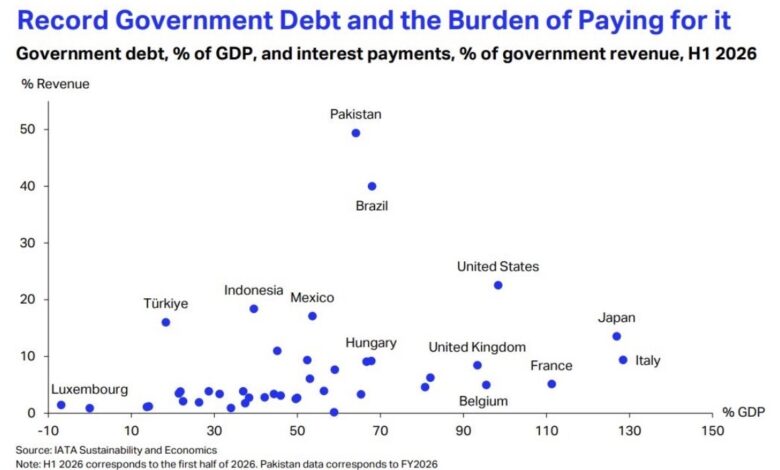
IATA’s analysis highlights significant differences in the burden of interest payments across countries. In Pakistan, interest payments account for nearly 50% of government revenue, compared with approximately 40% in Brazil and 22% in the United States. In Türkiye, the figure stands at approximately 16%, while government debt represents around 18% of GDP, according to the chart.
The report also reveals the scale of the financial burden facing major economies. In the United States, federal debt exceeded $40 trillion in 2026, while annual net interest costs reached $1.05 trillion, equivalent to more than one-fifth of federal revenue. Pakistan, despite having a much smaller government debt of approximately $290 billion, paid around $31 billion in interest, consuming nearly half of its government revenue.
IATA also warned that several developing economies, including Egypt, Kenya, Pakistan and Tunisia, face severe fiscal and financing pressures. Lebanon and Venezuela remain in default, while countries such as Ghana, Zambia, Sri Lanka and Suriname continue to face economic challenges following debt restructuring.
Advanced economies are not immune to these pressures. According to IATA, countries including Italy, Japan, France and Belgium already exhibit characteristics of prolonged fiscal stagnation, with rising taxation and increasingly limited fiscal flexibility. The United Kingdom, the United States and Spain are also at risk of moving in a similar direction.
IATA emphasized that growing debt burdens could restrict public investment, weaken economic growth and increase dependence on further borrowing, creating a cycle in which rising debt slows economic activity while weaker growth makes debt increasingly difficult to reduce.